
Across Bangladesh, something interesting is happening with mushrooms.
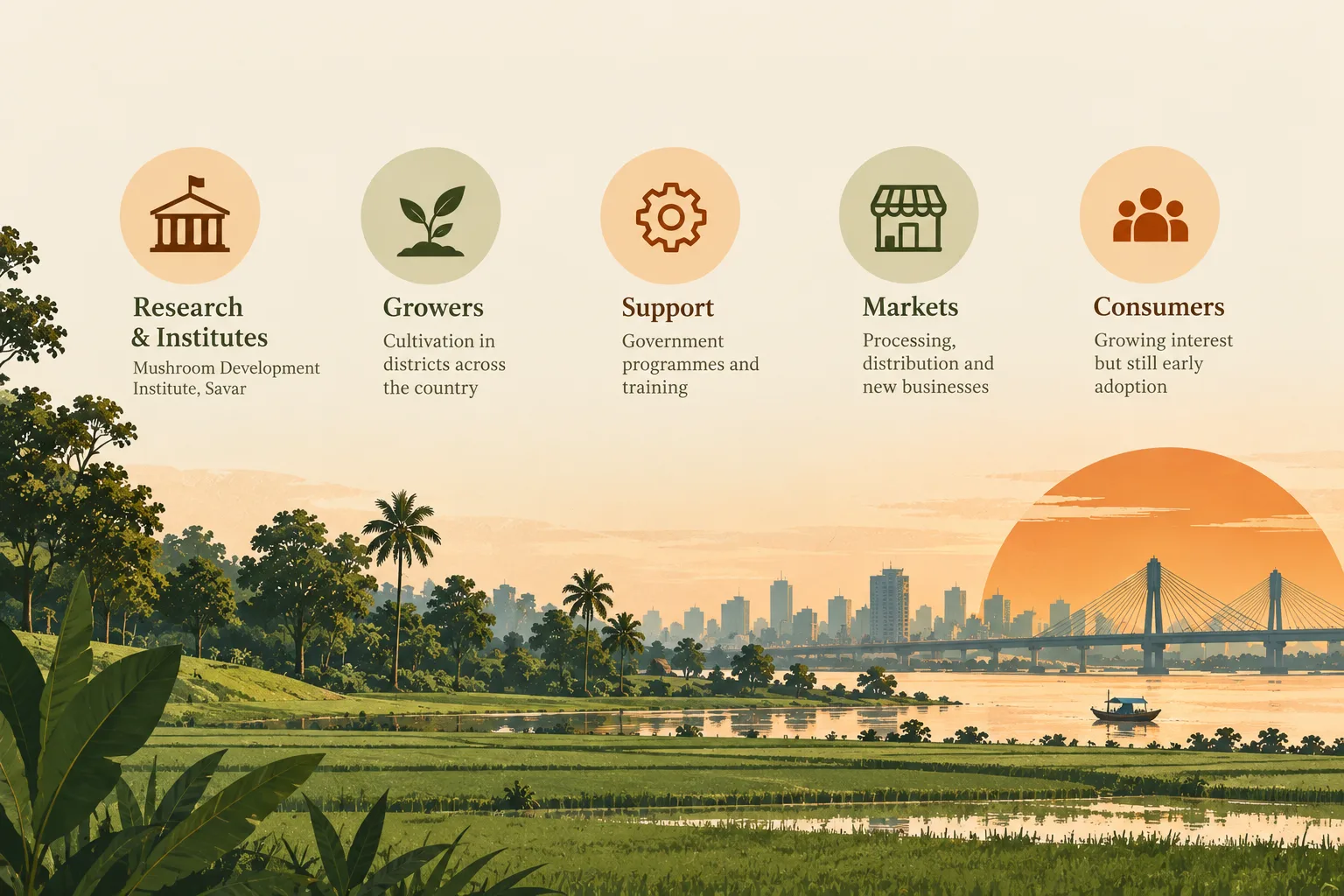
In Savar, there is a dedicated Mushroom Development Institute. In different districts, small growers and new entrepreneurs are taking up cultivation. Government programmes are providing training and working on production, processing and market connections. And in kitchens, restaurants and online food communities, more people are encountering mushrooms in forms that go beyond the familiar.
Yet mushrooms are still far from being an everyday ingredient in most Bangladeshi homes.
That contrast is what makes this moment interesting.
Bangladesh already has a mushroom story. But much of it is still being written.
From a specialist crop to a growing sector
Mushroom cultivation in Bangladesh is not new.
What is changing is the attention surrounding it.
The Department of Agricultural Extension is currently running a five-year national project from 2023 to 2027 focused specifically on expanding mushroom cultivation, improving nutrition and creating income opportunities. Its plans include developing entrepreneurs, expanding cultivation models around the country, improving production technologies and strengthening the capacity of the Mushroom Development Institute in Savar.
And this activity is not limited to one type of mushroom.
Government agricultural information identifies commercial cultivation in Bangladesh of varieties including oyster, reishi, milky, wood ear and button mushrooms. Oyster remains particularly prominent, but the range itself tells an important story: the country's mushroom landscape is broader than many consumers may realise.
Recent reports also show small-scale entrepreneurs cultivating mushrooms in places such as Brahmanbaria, Bagerhat and Narail, sometimes beginning with remarkably little space. These individual stories should not be mistaken for national statistics, but they do show how mushroom cultivation is appearing in different parts of the country.
Growing mushrooms is only half the story
Producing more mushrooms does not automatically make mushrooms part of everyday food culture.
People also need to know where to find them, what to do with them and, perhaps most importantly, feel comfortable cooking them.
A 2026 study of 336 educated urban adults in Bangladesh offers an interesting glimpse into that gap.
More than three-quarters of respondents said they had eaten mushrooms at least once. Yet only 36.9% reported having purchased fresh mushrooms. Among those who had not, frequently reported barriers included market availability, price, lack of knowledge about cooking mushrooms and concerns about safety. Because the study used a convenience sample of educated urban adults, its findings should not be treated as representative of the entire country. But they highlight an important challenge.
The opportunity is therefore not simply to grow more.
It is to build familiarity.
Making mushrooms feel less unfamiliar
For mushrooms to become part of everyday cooking, people need more than products.
They need ideas.
How do you cook shiitake?
What does wood ear taste like?
Can mushrooms work in familiar Bangladeshi dishes?
How should dried mushrooms be prepared?
What is the difference between oyster, button, enoki and lion's mane?
These may sound like simple questions, but answering them matters.
Even Bangladesh's agricultural authorities have identified consumer awareness, cooking knowledge, processing and market linkages as areas requiring further attention.
This is where the next stage of the sector becomes particularly exciting.
It is not only about cultivation. It is also about what happens between the grower and the plate.
There is room for a much bigger mushroom culture
Bangladesh already has growers, researchers, agricultural programmes, entrepreneurs and consumers interested in mushrooms.
It also has challenges.
Fresh mushrooms are perishable. Distribution matters. Reliable production and quality matter. Processing matters. Consumers need confidence and practical knowledge. And growers ultimately need markets capable of absorbing what they produce.
Research on Bangladesh's mushroom sector has repeatedly identified factors such as training, marketing, post-harvest processing and access to appropriate inputs as important to the industry's development.
None of this means mushrooms will suddenly become a staple across Bangladesh.
Food culture rarely changes overnight.
It changes when an unfamiliar ingredient becomes a familiar one.
When someone learns how to cook it.
When a restaurant puts it on a menu.
When a grower finds a reliable customer.
When a family tries a new variety and decides to buy it again.
A story worth following
Perhaps that is the most exciting part of Bangladesh's mushroom story today.
There is still so much room for it to grow.
Not simply in tonnes produced or farms established, but in knowledge, recipes, processing, distribution, research, businesses and the number of people who see mushrooms as an ordinary ingredient rather than an unusual one.
At Just Mushrooms, that wider story matters to us.
We want to learn from the people already growing, researching, cooking and working with mushrooms across Bangladesh - and help more people discover just how varied this world can be.
Because the future of mushrooms in Bangladesh will not be shaped by one farm, one company or one variety.
It will be shaped by the people who grow them, cook them, study them, share them and find new possibilities for them.
And that story is only beginning.