
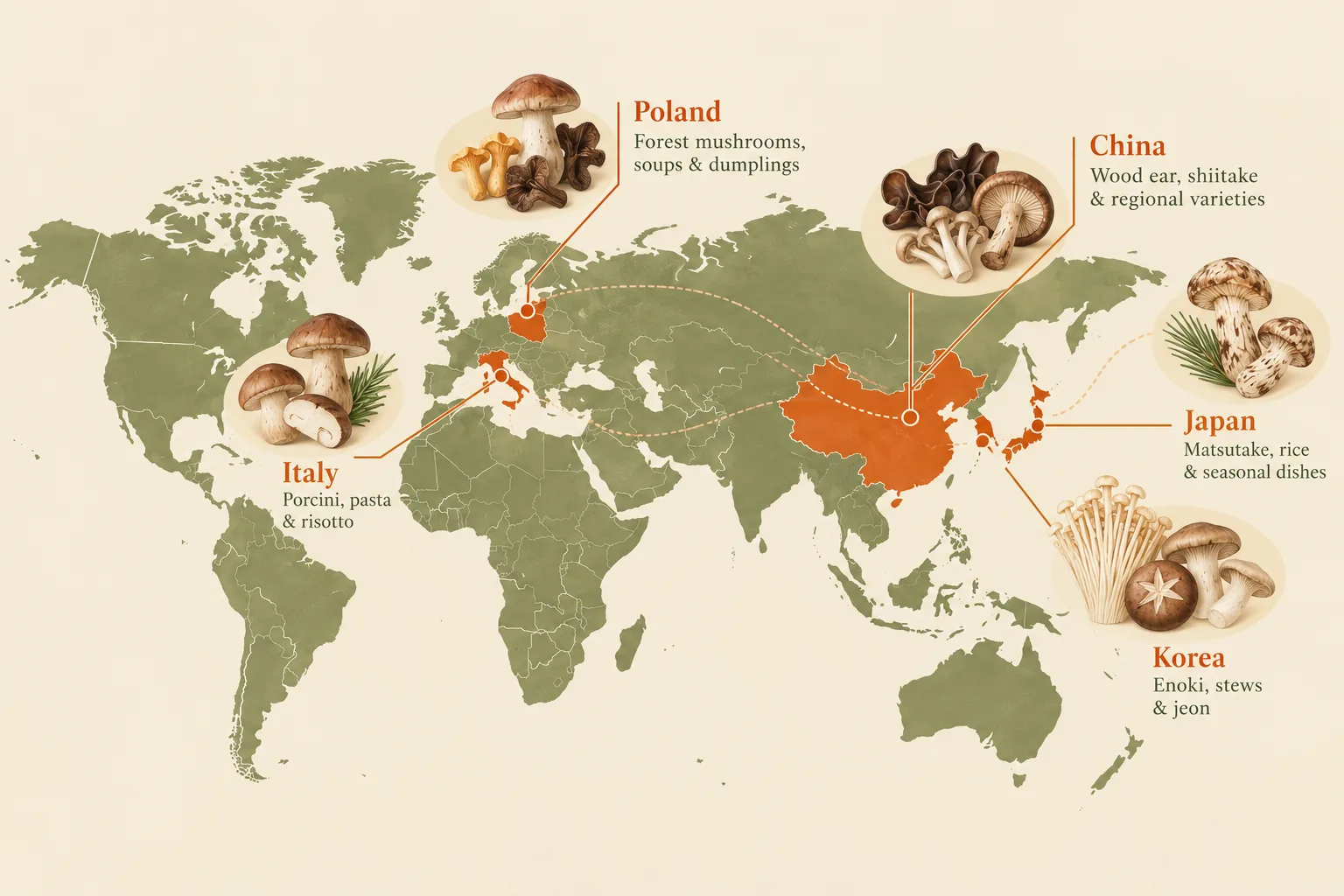
Ask five people from five different countries what comes to mind when they hear the word mushroom, and you may get five completely different answers.
For one person, it might be shiitake simmering gently in a Japanese broth.
For another, the unmistakable crunch of wood ear in a Chinese dish.
In Korea, mushrooms might appear in a bubbling stew or a pan-fried jeon. Travel to Italy and the conversation may turn to porcini with pasta, risotto or polenta. In Poland, it could mean forest mushrooms gathered in season, dried for later, then brought out for soup or pierogi.
Same kingdom of ingredients.
Completely different food cultures.
And that may be one of the most fascinating things about mushrooms.
Japan - where the mushroom can be the occasion
In Japan, mushrooms do not belong to just one kind of cooking.
Shiitake can be sautéed when fresh, while dried shiitake is particularly suited to simmered dishes and soups, where its aroma and savoury character can become part of the surrounding liquid. Japan's Ministry of Agriculture notes that shiitake has been eaten in the country for centuries, with cultivation methods developing further during the Edo period.
Then there is matsutake.
Here, the mushroom becomes something quite different.
Matsutake is prized particularly for its aroma and is closely associated with autumn. In Kyoto, for example, it appears in matsutake gohan, where thin slices are cooked with rice and kombu dashi. It can also be served in clear soup, sukiyaki and other seasonal dishes.
Japanese government records describe Kyoto-grown matsutake as a premium ingredient, with the season generally running from September into early November.
It is a lovely example of how a mushroom can be more than something added to a dish.
Sometimes, the arrival of the mushroom is part of the season itself.
China - a mushroom can be soft, crisp, meaty or almost delicate
Move across to China and the mushroom world becomes enormous.
Shiitake appears fresh and dried in stir-fries, soups and stews. Wood ear brings something completely different - a distinctive texture that allows it to work in salads, stir-fries, braises and soups.
Then there are oyster mushrooms, tea tree mushrooms, bamboo fungus, white and brown beech mushrooms and an extraordinary range of wild fungi, particularly associated with regions such as Yunnan.
One Chinese culinary guide describes bamboo fungus as valued for its light flavour and crunchy texture, often appearing in soups and hotpot dishes. Shiitake, meanwhile, is widely used in soups, stews and stir-fries.
This variety has deep roots.
Written Chinese knowledge of fungi goes back many centuries, while records of traditional cultivation techniques for shiitake, wood ear and other fungi were later documented and developed into modern cultivation methods.
But perhaps the more interesting point for today's eater is much simpler.
In Chinese cooking, "mushroom" does not describe one texture.
One can be soft and deeply savoury.
Another can be almost crunchy.
Another absorbs the flavour of a broth.
Another becomes the centre of the dish.
Once you experience mushrooms this way, the idea of mushrooms as a single type of ingredient starts to disappear.
Korea - mushrooms woven into everyday dishes
In Korean cooking, mushrooms often appear alongside other ingredients rather than demanding the entire spotlight.
Enoki can slip into a bubbling soup. Shiitake can add flavour and texture to a stew. Oyster mushrooms can be stir-fried, seasoned or used in plant-focused dishes.
Korean temple cuisine offers a particularly interesting example. Korea's official cultural information describes shiitake, oyster and wood ear mushrooms as important ingredients, prepared through methods such as stir-frying and braising and valued for their savoury flavour and texture.
Mushrooms also appear in jeon, the broad family of Korean pan-fried dishes. Some versions use pyogo, or shiitake, coated with flour and egg before being fried. Jeon itself has travelled from more elaborate historical cooking into something now widely enjoyed in Korean everyday food culture.
And enoki?
It is very much at home in the bubbling dishes many people now associate with Korean food. Korea's official food writing includes enoki in dishes such as sundubu-jjigae, the spicy soft-tofu stew served fiercely hot in its pot.
Here, mushrooms do not need to be unusual.
They simply belong.
Italy - when the forest meets the plate
Italy gives us another relationship with mushrooms entirely.
Think porcini.
Not as an exotic ingredient, but as something connected to forests, seasons and regional cooking.
Across different parts of Italy, porcini find their way into risotto, pasta, polenta and sauces, as well as being sautéed or fried.
Around Fornovo di Taro in Emilia-Romagna, for example, porcini have protected geographical status as part of the local gastronomic identity. They are served in risotto, with polenta or tagliatelle, sautéed and fried.
Elsewhere the combinations change.
In parts of Le Marche, polenta is served with mushrooms gathered from nearby forests, while official Italian tourism material documents porcini appearing alongside pasta and in regional mountain cooking across the country.
There is something beautifully uncomplicated about this relationship.
Find a good mushroom.
Cook it with good pasta, rice or polenta.
Let it taste like itself.
Poland - where summer and autumn can survive into winter
Then there is Poland, where mushrooms have an unusually close relationship with the forest.
Wild mushroom picking has long been part of Polish food culture, and the mushrooms that come home do not necessarily have to be eaten immediately.
Some are cooked fresh.
Some are pickled.
And some are dried.
That last part becomes especially important when winter arrives.
Dried forest mushrooms are used in soups, sauces and fillings. They appear with sauerkraut, inside pierogi and in uszka, the small mushroom-filled dumplings traditionally served with red borscht.
At Christmas Eve dinner, mushrooms become particularly visible. Traditional dishes include wild mushroom soup, sauerkraut with mushrooms and pierogi filled with sauerkraut and mushrooms.
But mushrooms are not confined to Christmas.
Polish food culture also includes seasonal chanterelles, fried or braised mushrooms, pickled mushrooms and dried porcini used to deepen sauces and other dishes. Historical research traces wild mushrooms through Polish culinary sources for centuries, with both fresh seasonal mushrooms and dried mushrooms used outside the growing season.
Here, drying does something beautiful.
It allows part of the forest season to follow people into another part of the year.
So, what does a mushroom taste like?
Perhaps that is the wrong question.
Shiitake does not behave like wood ear.
Enoki does not behave like porcini.
Matsutake is prized for qualities entirely different from those of an oyster mushroom.
And the same mushroom can become something different again depending on the kitchen it enters.
It can disappear into a broth.
Crunch between chopsticks.
Fill a dumpling.
Sit beside polenta.
Flavour a pot of rice.
Or become the ingredient everyone waits for when a particular season returns.
There is no single "mushroom cuisine".
There are thousands of relationships between people, places and fungi.
Our idea of "normal" is surprisingly local
This may be the most interesting lesson on the mushroom map.
What feels unfamiliar to us can be completely ordinary somewhere else.
A Bangladeshi cook seeing wood ear for the first time might wonder what to do with it.
In another kitchen, its texture is precisely the reason it was chosen.
Enoki might look unusual if the mushrooms we grew up knowing were mostly button or oyster.
Elsewhere, dropping a bundle of enoki into a bubbling soup requires almost no explanation.
The ingredient did not change.
The food culture around it did.
And food cultures are never completely finished.
We discover ingredients. We borrow ideas. We adapt dishes. Something that once looked unfamiliar appears on the table a second time, then a third.
Eventually, we stop asking what we are supposed to do with it.
We simply start cooking.
Perhaps that is the most exciting thing about looking at how the world eats mushrooms.
Not that one country has found the "right" way.
Quite the opposite.
The same extraordinary family of ingredients has found hundreds of different ways to belong.